Our first NeurIPS main-track paper: The Alien Space of Science
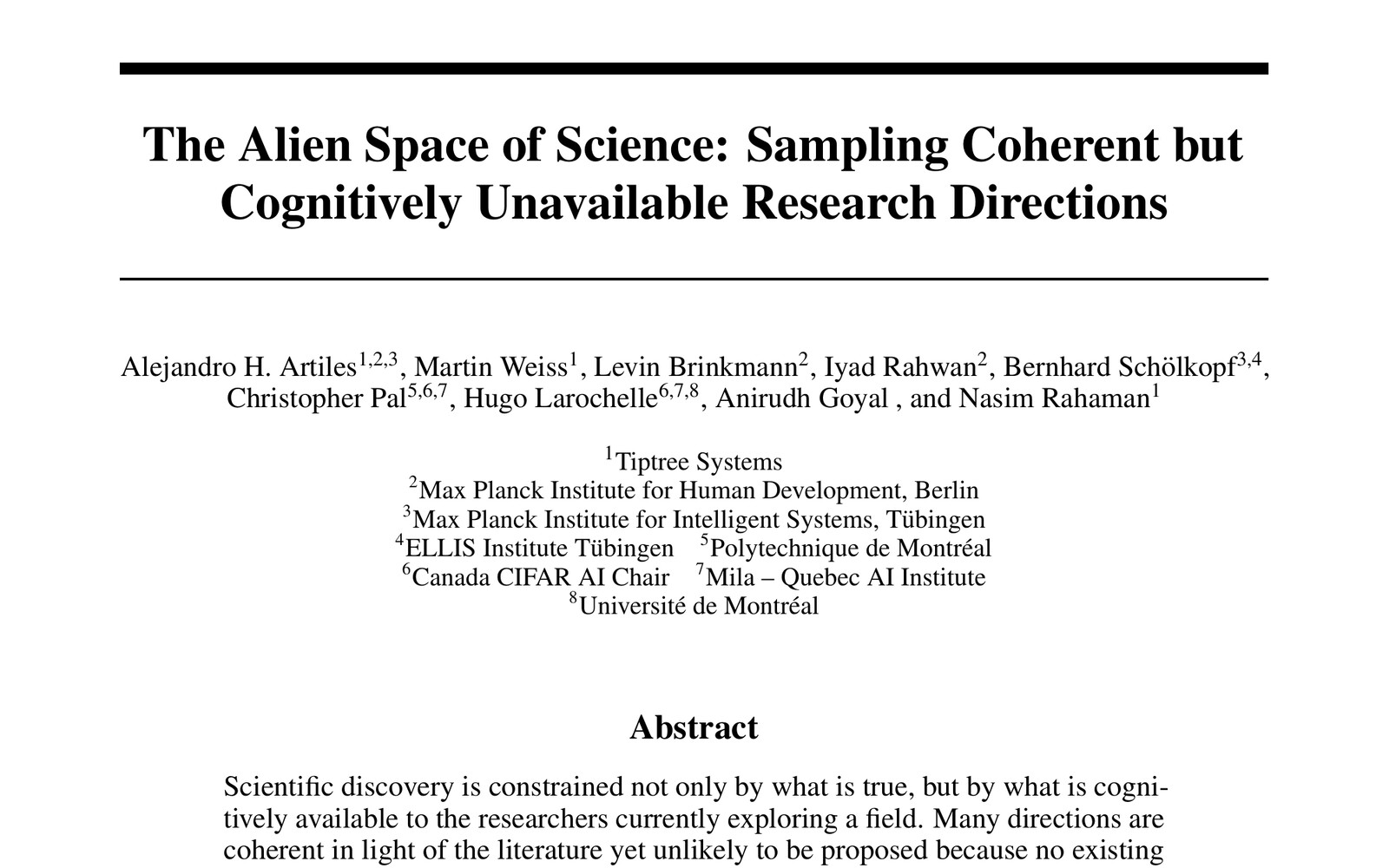
Pleased to announce the first main-track NeurIPS paper of my Postdoc and Tiptree Systems!
We built a way to sample good ideas - ideas that make scientific sense, but that no existing research community is positioned to propose.
The way it works is like this:
Take 16,068 LLM papers (NeurIPS, ICLR, ICML, ACL, EMNLP, 2017 to 2025) are broken into 273 "idea atoms". Every paper, and every candidate idea, becomes a set of atoms.
Train a Coherence Model: a 42.8M-parameter transformer trained on papers as sequences of atoms. Basically a language model whose tokens are ideas.
Train a Cognitive-Availability Model: a dual encoder trained on the publication histories of 39,791 researchers, which predicts where each person could plausibly go next.
Use those models to score sampled tuples using reciprocal rank fusion (you want ideas that go together well, but that are not cognitively available to anyone).
Oh and since then we scaled it way up to a couple million papers and 10,000,000's of concept elements, generating 25,000 new research proposals that you can search over here: lacuna.tiptreesystems.com/explore?view=hypotheses
Thanks to Hugo Larochelle and Chris Pal for supervising me through it, and for Alejandro H. Artiles leading the charge for creativity in machines. See you in Sydney!
- Project page: tiptreesystems.com/research/alien-space-of-science
- Paper: The Alien Space of Science: Sampling Coherent but Cognitively Unavailable Research Directions
- Code: github.com/alejandrohdez00/alien-space-of-science
First posted on LinkedIn, October 22, 2026.